

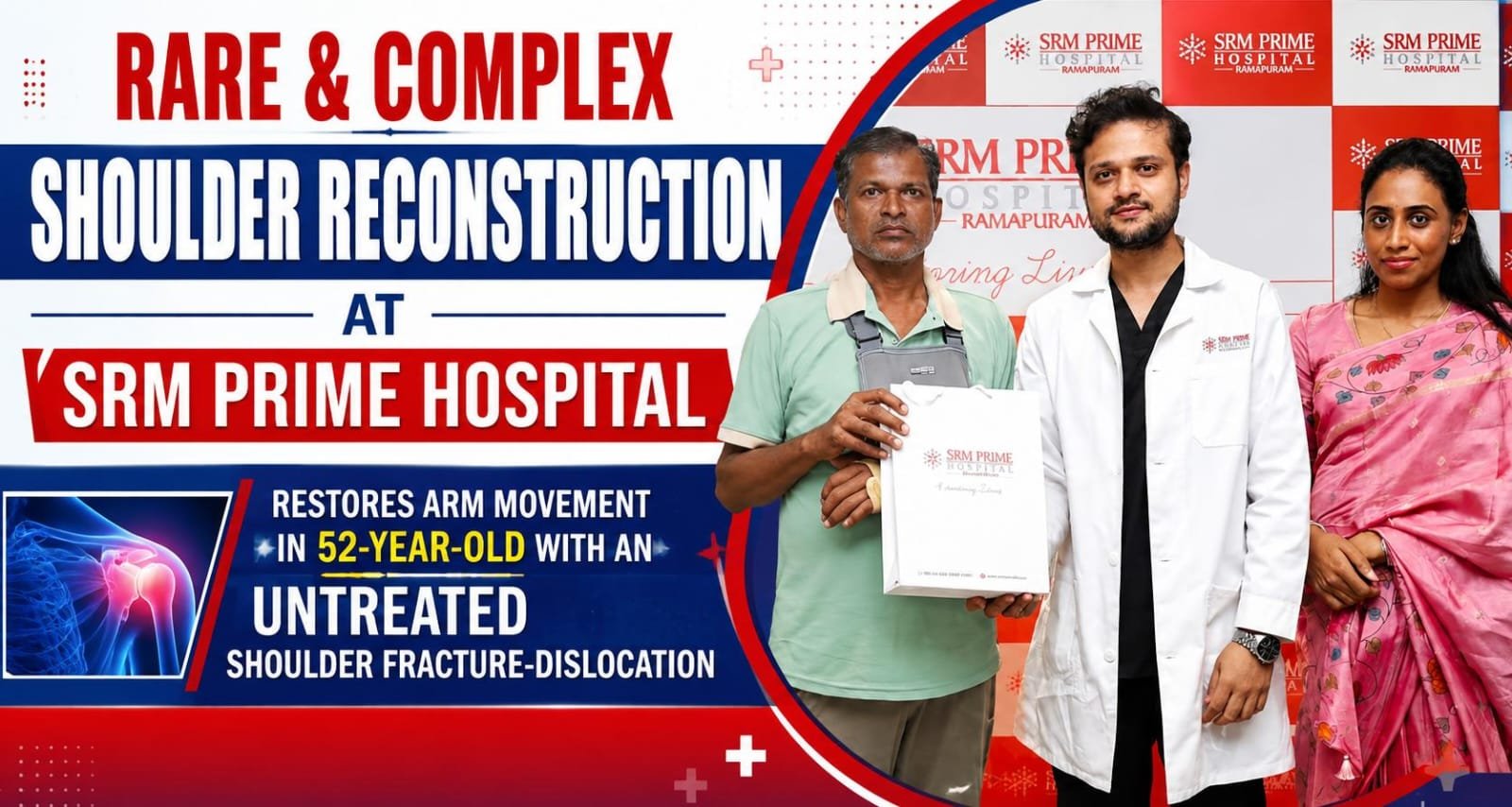
Chennai, August 11, 2026: In a rare and complex reconstructive surgery, SRM Prime Hospital relieved pain and restored movement in the left upper arm of a 52-year-old man, from Jharkhand, who had neglected a fracture-dislocation of his left shoulder for nearly six months. Over time, the untreated injury progressed to a chronic dislocation, leading to extensive soft-tissue scarring, formation of a pseudo-joint elsewhere, and compression of the brachial plexus, the network of nerves that controls movement and sensation in the shoulder, arm and hand.

Using advanced surgical techniques and a multidisciplinary approach, the surgical team successfully restored the shoulder to its anatomical position while carefully protecting and decompressing the major nerves and blood vessels nearby. The procedure also restored the shoulder’s normal contour. The patient was discharged after five days in the hospital with significant pain relief and encouraging improvement in the movement of his left upper arm. He is currently undergoing a structured rehabilitation program under the guidance of the Physiotherapy and Rehabilitation team and is making steady progress toward regaining strength, mobility and functional independence.
As the shoulder remained dislocated for nearly six months, the head of the upper arm bone (humeral head) had shifted far from its normal position and became trapped within dense scar tissue. The surgical team placed the displaced bone back into its normal position. They then released the tightened joint capsule and removed scar tissue that had formed around the joint to free the shoulder and restore its normal movement.
To improve the long-term stability of the shoulder, the surgeons performed a Latarjet procedure, a specialised operation in which a small piece of bone called the coracoid was transferred to the front of the shoulder socket. This bone transfer acts as an additional support, significantly reducing the risk of the shoulder dislocating again.
As the prolonged dislocation had caused scar tissue to compress the brachial plexus, the Plastic Surgery team simultaneously carried out brachial plexus neurolysis, a delicate procedure to free the nerves from surrounding scar tissue and adhesions. This relieved pressure on the nerves, protected them during the reconstruction and maximised the chances of restoring strength, movement and sensation in the affected arm.
The combination of these advanced, and a few other specialised, procedures enabled the surgical team not only to restore the shoulder to its normal anatomical position but also to relieve pain, improve stability, protect the nerves and optimise the patient’s long-term functional recovery.
The surgery was carried out by a multidisciplinary team comprising Dr. Nikhil Jawaharlal Nahar, Consultant – Shoulder & Orthopaedic Surgeon; Dr. Lokesh Suryanarayanan, Consultant – Plastic Surgery along with Dr. Subashini, Senior Consultant – Plastic Surgery; Dr. K Partheeban, Clinical Lead & Senior Consultant – Anaesthesia. The orthopaedics team performed the complex shoulder reconstruction, including the Latarjet procedure. Dr. Lokesh and the Plastic Surgery team freed the nerves from scar tissue and adhesions to relieve compression and preserve nerve function. Intraoperative electrodiagnostic study of the nerves was done. Post-operatively, the patient has been recovering steadily and is undergoing a structured rehabilitation program under the guidance of the Physiotherapy and Rehabilitation team, with encouraging progress toward regaining function and mobility.
In his comments, Dr. Nikhil Jawaharlal Nahar, said, “This was one of the most challenging shoulder reconstructions because the injury had been neglected for nearly six months. By the time the patient reached us, the shoulder had become chronically dislocated, with extensive scar tissue and compression of the brachial plexus. The displaced humeral head was also lying dangerously close to the axillary artery, the main blood vessel supplying the arm, making the surgery particularly demanding. Our priority was to restore the shoulder to its normal anatomical position while carefully protecting the nerves and blood vessels. This required meticulous planning, advanced imaging, intraoperative nerve monitoring and close collaboration between orthopedics, plastic surgery, anaesthesia and rehabilitation teams. After an eight-hour surgery, the patient experienced significant pain relief and regained movement in his arm, giving him the opportunity to return to his normal life and livelihood.”
Mr. Siva, CEO, SRM Prime Hospital, said, “This case reflects the level of expertise and multidisciplinary collaboration required to manage some of the most complex orthopedic conditions. Even after six months of neglect of the fracture-dislocation, our teams were able to successfully reconstruct the shoulder using internationally accepted advanced surgical techniques, meticulous planning and seamless coordination across multiple specialties. Such cases demand not only surgical precision but also careful execution to restore function while preventing further injury to critical nerves and blood vessels. At SRM Prime Hospital, we are committed to delivering world-class, evidence-based care for highly complex conditions, enabling patients to regain mobility, independence and a better quality of life.”
The surgical team emphasised that shoulder fractures and dislocations should never be ignored – especially if there is persistent pain, visible deformity, inability to move the arm, weakness or numbness after an injury. Early evaluation and appropriate imaging following a significant shoulder injury are crucial to prevent chronic deformity, nerve and blood vessel compression, and permanent loss of function.